
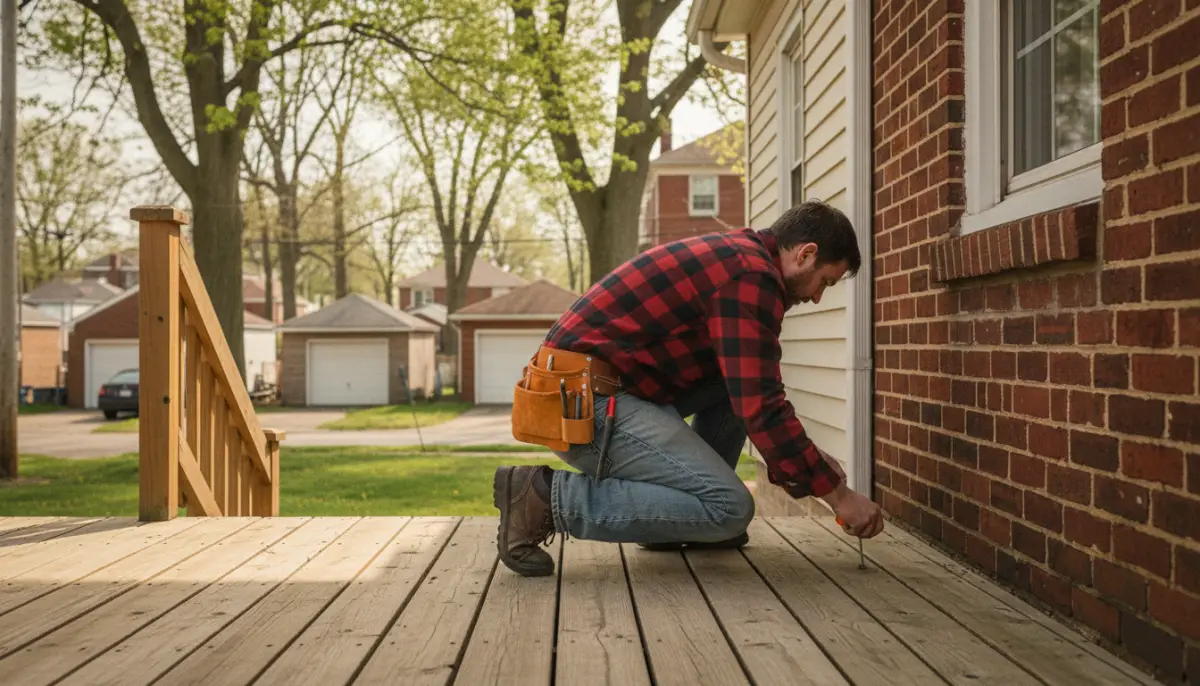
Spring Deck Check: 5 Failures We See After Toledo Winters
Five deck failures Toledo homeowners miss every spring — from ledger rot to cracked stair stringers — and what each one actually costs to repair.
Last March a homeowner near Sylvania called about a bouncy spot at the top of her deck stairs. We got there, pressed a flathead screwdriver into the stair stringer, and it sank two inches. The post base had been holding standing water since November. Four months of Toledo freeze-thaw cycles did what six years of summer cookouts hadn’t — destroyed the structural core of a stair assembly that cost $750 to rebuild. If she’d called in October when she first noticed the wobble, it would have been a $90 repair.
That’s the math with Toledo deck damage. Catch it in May, pay a fraction. Our $89 standard visit covers a full inspection with photo documentation through our customer portal. Call 419-574-5623 and we’ll get on your schedule before the deck furniture goes back out.
Why Toledo Winters Are Hard on Deck Boards
NW Ohio averages around 34 inches of snow per winter. The damage isn’t the snow — it’s the 40-plus freeze-thaw cycles between November and March. Toledo regularly swings between 12°F and 48°F in the same week. Every time water trapped in a board joint, screw hole, or ledger gap freezes and expands, it forces the material apart by fractions of an inch. A hundred cycles of that and you’ve got rot channels, cupped boards, and post bases that are already compromised before you set foot outside in May.
Toledo’s clay-heavy soil makes it worse. It doesn’t drain fast. Post bases and deck footings in low-lying parts of Maumee, Point Place, and South Toledo sit in standing water for weeks after snowmelt — longer moisture exposure, faster deterioration — especially on pressure-treated lumber that’s already 15 or 20 years old.
Failure #1: Ledger Board Rot Behind the Flashing
The ledger is the piece of lumber bolted directly to your house that carries one end of every deck joist. It’s the most structurally critical piece on the deck, and it’s almost always the first to rot. The flashing that’s supposed to keep water out of the gap between the ledger and house siding fails within 10–15 years on most Toledo installations. Water gets behind it, the rot runs in both directions — into the ledger and into the rim joist of the house itself.
Test it yourself: drive a flathead screwdriver horizontally into the gap where the ledger meets the siding. Sinks more than half an inch — you’ve got rot starting. Sinks two inches or more — the ledger needs replacement before the deck is safe to load.
In West Toledo and Perrysburg, where a lot of pressure-treated decks went up in the early 2000s, we find this on roughly one in three properties we visit. Ledger replacement on a 12×16 deck runs $400–$700, depending on how far the damage has spread into the house’s rim joist.
Failure #2: Post Bases Sitting in Standing Water
Deck posts should sit on metal standoffs that hold the wood an inch or more above concrete — not directly on the slab, not set into the ground. On decks built before 2005 in Holland, Sylvania, and Toledo’s older Westgate neighborhoods, we routinely find posts sitting flat on concrete with no metal base, or buried directly in soil. End grain soaks water up like a straw.
Probe the bottom six inches of every post with a screwdriver. Soft wood at the base — even when the rest of the post looks solid — means the post is compromised. What you feel on the surface is typically 30–40% of the actual rot column; the worst of it is inside the wood where water wicked up over years.
A single post and footing replacement runs $150–$300. Five compromised posts on the same deck runs $750–$1,500. Either way, far cheaper than a structural failure.
Failure #3: Popped Screws and Lifting Board Ends
Walk the deck slowly. Every screw head that catches your foot, every board end that’s curled up at a seam — those are water entry points. When boards cup and gap, water doesn’t run off. It pools in the gaps and soaks down into the joists below.
On pressure-treated decks from the mid-1990s, the lumber has been through 30-plus Toledo winters. The wood fiber is at its limit. Refastening loose boards on a 192-square-foot deck is usually a half-day job. If more than 30% of board ends are lifting, it’s more cost-effective to re-deck the full surface than to address boards individually. Full deck board replacement on a 12×16 runs $600–$1,100, depending on whether you go back to pressure-treated or switch to composite.
Failure #4: Railing Wobble
Grab every railing post at the top. Push forward, pull back, push sideways. Anything that moves more than a quarter-inch is a structural failure — not “a little play.” Ohio Building Code (ORC 4101.2) requires deck railings at 36 inches for decks up to 30 inches above grade, and those railings must support 200 pounds of force in any direction. A wobbly post doesn’t come close to that standard.
Most railing post failures on Toledo decks trace back to two things: undersized through-bolts (3/8” where 1/2” was spec’d) and corroded post base hardware. Replacing three or four wobbly posts with through-bolt repair and new base hardware runs $250–$450. Ignore it and you’re looking at a full railing section replacement — $600–$1,000 — after the failure you were trying to avoid.
Failure #5: Stair Stringer Cracks
This is the one that puts people in the ER. Stair stringers are the diagonal 2×12 boards that support your treads. When the concrete footing at the bottom of the stair heaves from frost — and Lucas County clay does this reliably, every winter — the stringer cracks along the tread notch cuts. The notch is already the weakest cross-section of the board. A crack there under a loaded step is a single event away from total failure.
Check the base of each stringer where it contacts the landing. Any settlement gap wider than 3/4 inch means the footing has moved. Any diagonal crack running from a tread notch toward the bottom edge means replace, not patch. A standard 3- to 4-step stair rebuild in Toledo runs $300–$600. The Sylvania homeowner from the opening had three cracked stringers. We rebuilt the full stair structure in one visit.
What a Spring Inspection Actually Costs — and What It Covers
Our $89 standard visit covers the complete deck inspection: ledger probe, post base check, board sweep, railing test, stair stringer inspection, hardware condition. Every finding is photographed through our customer portal at /portal so you have a documented record — useful for insurance, useful if you’re selling the home.
If we find repairs on the same visit, we can often complete minor items that same day, and the visit fee applies toward labor. No double billing for the diagnostic time.
Call 419-574-5623 to schedule. Full deck rebuilds, re-decking, and ledger work are covered under our decks and patios service. If the spring walkthrough turns up fence issues at the same time, we handle fence installation and repair in the same visit.
How much does a spring deck inspection cost in Toledo?
The $89 standard visit covers the full inspection and photo documentation through the portal. If repairs happen on the same visit, the $89 applies toward labor — you’re not billed twice for the diagnostic time already spent on-site.
How long does ledger replacement take on a typical Toledo deck?
A ledger swap on a 12×16 deck takes 4–6 hours. That covers pulling the joists back temporarily, removing the rotted ledger, installing new pressure-treated material, and re-flashing the siding connection. Total cost in Toledo: $400–$700, including materials.
Can I re-stain the deck without doing structural repairs first?
No. Stain is a surface coating that slows future water intrusion but does nothing for rot underneath existing boards. Sealing over rot traps moisture and accelerates the decay column. Fix structure first, finish second.
How many freeze-thaw cycles does Toledo average per winter?
Toledo averages 35–45 freeze-thaw cycles between November and March. That’s 35–45 separate expansion-and-contraction events in every water-infiltrated joint on your deck — which is why Toledo decks deteriorate faster than in cities with colder but more consistent winters.
Submit it through the portal
$89 standard visit. Same-day quote. Live photos.
Request a Service