
LVP Flooring in Toledo: What Subfloor Surprises Cost You
LVP flooring looks simple until you pull up the old carpet and find what 60 years of Toledo winters did to the subfloor. Here's what drives the real cost.
Sixty percent of LVP jobs we run in Toledo go exactly as quoted. The other forty percent hit a subfloor problem nobody saw coming — and that problem is what separates a $600 install from a $1,200 one. The floor itself isn’t the variable. What’s under it is.
Our standard visit is $89. We walk the room, check for soft spots, measure the square footage, and give you a complete written number before anyone starts work. Call 419-574-5623 or submit a request through the portal and we’ll respond same-day.
What LVP Installation Actually Involves Before a Plank Goes Down
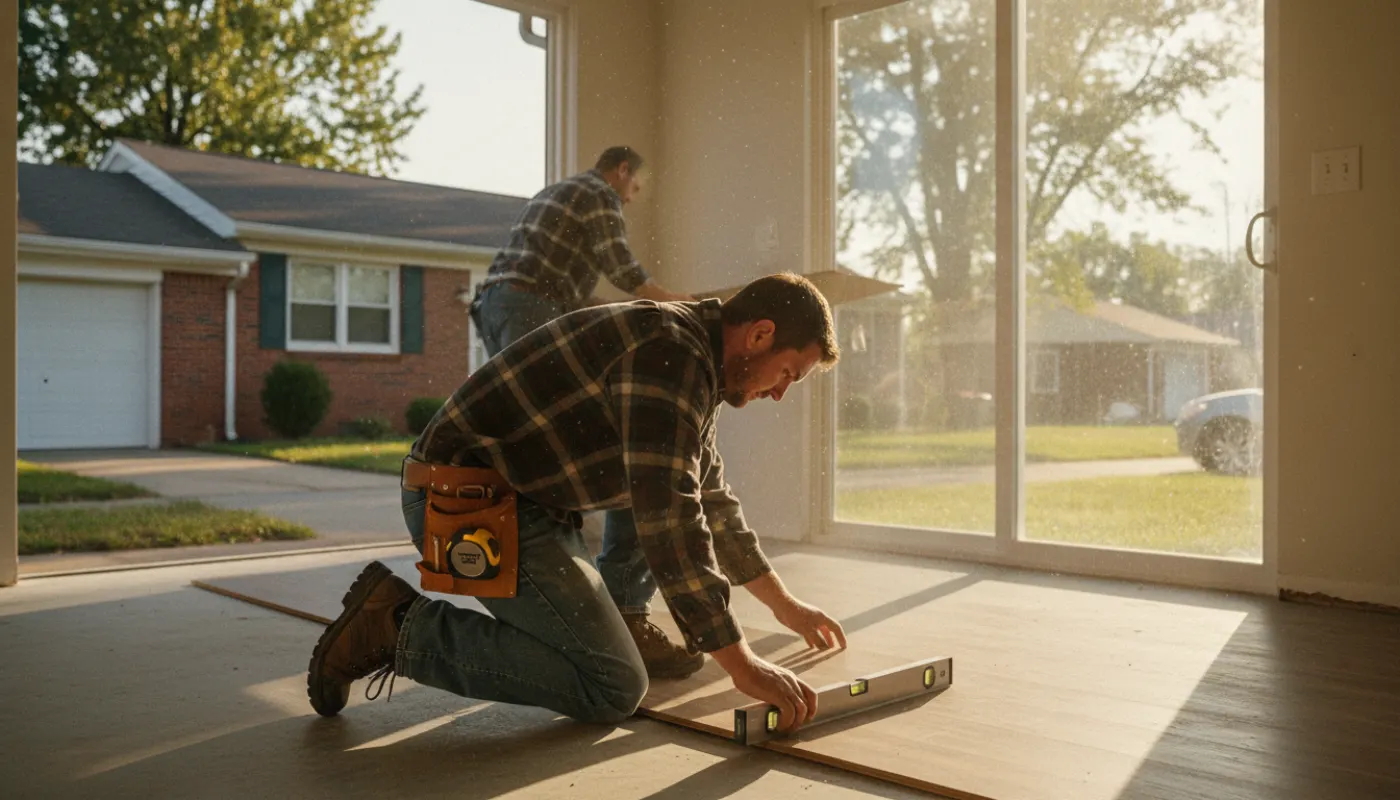
LVP is a floating floor — the planks click together and sit on top of the subfloor without glue or nails in most residential applications. That sounds simple. The catch: a floating floor transfers every flaw in the subfloor directly to the surface above it. A high spot under a plank creates a click when you step on it. A low spot causes the click-lock joint to flex and eventually crack.
Before the first plank goes down, we check the subfloor for flatness. The industry standard is no more than 3/16-inch variation over a 10-foot run. In Sylvania and West Toledo, where most of the housing stock is 1950s–1970s construction, we hit that tolerance about 60% of the time without any prep work. The rest need grinding, self-leveling compound, or shimming — and that prep step is what most flooring quotes leave out.
What Toledo Houses Actually Look Like Under the Carpet
Post-WWII construction in Point Place and North Toledo ran some homes on 1x6 plank subfloor instead of plywood. Planks gap and shift. They’re harder to flatten and harder to screw down when they squeak. LVP floats fine over them if they’re tight — if they’re not, we nail them down or apply a skim coat first.
The other common find: the previous owner installed peel-and-stick vinyl tile directly over the plank subfloor, then carpet over that. You’ve got a 3/8-inch height mismatch at every doorway, and the vinyl is bonded too well to pull cleanly. In most cases, we float the LVP over the old vinyl if it’s fully adhered and flat. If it’s bubbling or peeling, it comes off first — add 1 to 2 hours of labor.
The subfloor condition is what we’re really looking at during the $89 diagnostic visit. Everything after that is predictable.
Old Carpet and Pad: The Removal Cost Most Quotes Leave Out
Carpet removal is straight labor. A typical 200–250 square-foot room takes about 45 minutes to pull the carpet, staple the pad, and load both into the trailer. Toledo and Lucas County don’t accept rolled carpet at curbside — it goes to a transfer station. We charge $75 to $125 per room for pull-and-haul depending on square footage and whether the pad is glued.
That’s separate from subfloor prep and separate from LVP material cost. A 200-square-foot bedroom with clean plywood subfloor, mid-grade LVP at $2.50 per square foot, standard install labor, and carpet removal runs $550 to $700 total. That’s the no-surprise number. Most jobs in West Toledo and Maumee come in right there.
Concrete Slabs in Toledo Basements and Finished Lower Levels
Perrysburg and Holland have more slab-on-grade construction in newer subdivisions. Older Toledo homes in Northwood and Oregon often have finished basement rooms on concrete. Two variables change everything there.
First: moisture. In NW Ohio, where lake-effect humidity runs high from April through September, concrete slabs can wick enough moisture to delaminate LVP without a vapor barrier. We run a moisture test before installing LVP on any concrete slab. High readings mean we add a 6-mil poly barrier or self-adhered membrane before the planks go down.
Second: flatness. Poured concrete is rarely as flat as it looks. We’ve ground high spots on basement slabs in Rossford and Walbridge before floating LVP — takes 2 to 4 hours on a typical 300-square-foot room. We build that into the quote up front.
LVP on a prepared concrete slab — vapor barrier, leveling, and install — adds $1.50 to $2.00 per square foot to the cost over a standard plywood job.
The Real Cost Breakdown
Here’s what drives the price on a LVP floor installation:
- Subfloor prep: $0 (clean, flat) to $400 (old tile removal, high spots, skim coat)
- Carpet removal and haul: $75 to $125 per room
- LVP material: $1.80/sq ft (builder grade) to $4.50/sq ft (commercial-grade 20-mil wear layer)
- Install labor: $1.50 to $2.00/sq ft for click-lock floating
- Transitions and trim: $15 to $35 per doorway; quarter-round at $1.00–$1.50 per linear foot
A full living and dining area, 400 square feet, mid-grade plank, plywood subfloor with light prep, carpet removal included: plan $1,000 to $1,500 total. That range covers most West Toledo bungalows and Sylvania ranch homes.
When LVP Isn’t the Right Call
Rooms with active moisture problems need that fixed first — LVP or anything else. A basement room that’s taken water twice isn’t ready for a floating floor. We’d rather say that up front than install something that buckles in 18 months.
Heavy commercial use — rolling carts, medical equipment, point loads — needs a 20-mil wear layer minimum. Most residential installs run 12-mil, which handles normal traffic and large dogs fine. Price difference is roughly $0.75 to $1.00 per square foot.
Mid-renovation rooms are another thing. If you’re mid-drywall installation, painting, or demo in Ottawa Hills or Sylvania, floor last — every time. Compound dust and foot traffic scratch the wear layer and void most warranties before the job is even done.
Get a Same-Day Quote in Sylvania, Maumee, or Anywhere in West Toledo
The biggest LVP mistake Toledo homeowners make: buying the flooring before anyone sees the room. Different LVP profiles have different acclimation requirements — some need 48 to 72 hours flat in the space. Some click-lock designs don’t work over radiant-heated subfloors. We help you pick the right product for your room before you drive to the flooring store.
Call 419-574-5623 or send a photo through the portal. We respond same-day, walk you through what subfloor prep you’re actually looking at, and give you a complete written quote before anyone shows up.
For a full overview: LVP floor installation in Toledo.
How long does LVP installation take for a typical Toledo room?
A 200-square-foot bedroom with a clean, flat subfloor — including carpet removal — takes 3 to 4 hours. Rooms needing concrete grinding or skim-coat prep can push to 6 to 8 hours total for a single space.
Can LVP go over existing vinyl tile?
Yes, if the tile is fully adhered, flat, and the height transition at doorways is under 3/8 inch. Loose or bubbling vinyl comes up first — plan an extra 1 to 2 hours of removal labor for a 200-square-foot room.
What LVP thickness works best for Toledo homes?
For standard rooms, 6mm to 8mm total with a 12-mil wear layer handles normal traffic and large dogs. Basements or any room with moisture history: go 8mm minimum, 20-mil wear layer. Price difference is $0.75 to $1.00 per square foot.
Do you handle the transition strips between rooms?
Yes. We install T-molding, reducers, and threshold transitions at every doorway — $15 to $35 each depending on profile and whether the existing threshold needs cutting. All transition hardware is included in the upfront quote.
Submit it through the portal
$89 standard visit. Same-day quote. Live photos.
Request a Service