
Smart Lock Install: August vs. Schlage in Older Toledo Homes
Toledo's pre-1960 homes make smart lock installs trickier than the box suggests — when August retrofits beat Schlage and what to check before you buy.
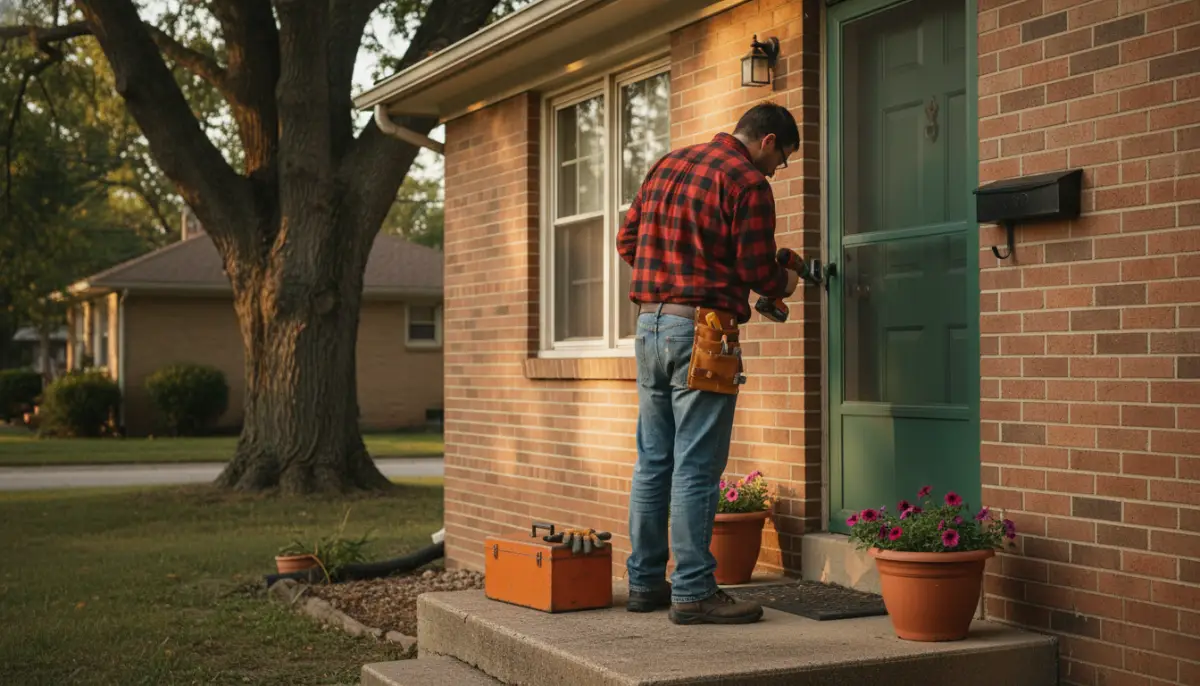
The house on Kenwood in Point Place was built in 1948. Original front door — 1-7/8” thick, a non-standard backset, and a deadbolt bore drilled slightly off-center by whoever “upgraded” it sometime in the 1970s. The homeowner had already bought a Schlage Encode Plus at Costco and couldn’t figure out why it wouldn’t seat right.
That’s the job we see three or four times a month across Toledo.
Smart lock installs on newer construction — Holland subdivisions, Perrysburg, Monclova — take 45 minutes and the lock drops in like it was designed for the door. On pre-1970 Toledo housing stock, it’s 60–90 minutes and sometimes a trip to Ace Hardware on Sylvania Avenue for a spacer kit or a bore bit. Knowing this before you buy saves real money. Call 419-574-5623 before you order anything — five minutes on the phone and we can tell you whether your door needs prep work. The $89 standard visit covers the diagnosis, install, and app setup.
Why Older Toledo Homes Are a Different Problem
Most smart lock specs assume a 1-3/4” door, a 2-3/8” or 2-3/4” backset, and a clean 2-1/8” bore hole. That’s what builders used from roughly 1980 onward.
Pre-1970 Toledo housing stock — Old West End, Point Place, Ottawa Hills, the Kenwood corridor, Westwood — often has:
- Door thickness 1-5/8” to 2”, outside the standard range. Some brands ship spacer kits; most don’t.
- Backsets of 2-1/4” or 2-5/8”, which fall between the two standard sizes. Schlage hardware won’t center right; you get a loose fit that rattles.
- Bore holes from the 1950s era — 1-1/2” diameter instead of the modern 2-1/8”. Getting a new lock to fit means boring it out.
- Mortise locks in pre-WWII houses. Smart locks don’t replace mortise hardware. That’s a full door repair project first.
None of this means you can’t have a smart lock. It means you need to know your door before you choose the hardware.
August Wi-Fi: Why It Wins on Pre-1960 Doors
August makes a lock that installs over your existing interior deadbolt. No removing the exterior hardware. No new bore hole. No backset measurement. The August Wi-Fi Smart Lock ($130–$160) replaces only the interior thumb-turn. Your keyed exterior plate stays exactly where it is.
That’s why August wins on pre-1970 Toledo doors. We’re not touching the door prep at all. The lock snaps onto the existing mechanism. Install time on a cooperative 1950s door: 20 minutes. App pairing: another 10.
The trade-offs worth knowing:
- Battery life is shorter than exterior-mount locks. Expect 4–6 months in NW Ohio — cold winters and mechanical operation pull more from the motor than from a warmer-climate install.
- No physical keypad on the standard August model. Access codes work through the app. There’s an optional August Keypad add-on ($50) if you want guests or tenants to punch in a code without their phone.
- The exterior hardware still uses a key. Some people see that as a security gap. August’s counterargument: two factors (key plus app code) is redundant protection, not a weakness.
For homeowners in Old West End or Ottawa Hills who have original 1940s or 1950s door hardware and don’t want to replace it — August is often the only major brand that handles the install cleanly.
When Schlage Encode Is the Better Pick
Standard door prep? Schlage Encode Plus is the right choice. It’s a full exterior replacement — keypad, deadbolt, and Wi-Fi built in. No hub. No bridge. No extra hardware.
Battery life runs 9–12 months in typical single-family use. Supports 100 access codes. The app is simple and works.
Schlage installs cleanly when:
- The bore is already 2-1/8” (sometimes updated by a previous owner during a lockout repair or a contractor remodel)
- The backset is 2-3/8” or 2-3/4” — measure from the door edge to the center of the existing bore
- Door thickness falls between 1-3/8” and 1-3/4”
If you’re not sure, send a photo of your exterior lock and interior thumb-turn through the portal. We’ll confirm whether your door needs prep before you spend $230.
Yale for Multi-Unit Landlords
Managing 4 or more doors — a small portfolio, a duplex, an Airbnb near Maumee — Yale Assure beats Schlage on the app side. Yale lets you view and manage multiple locks at once, set expiring codes across units, and get low-battery alerts.
The physical install requirements are the same as Schlage (exterior replacement, same door-prep specs). But for multi-lock management, Yale’s interface is materially better. It’s what we recommend to most Toledo-area landlords running more than 3 properties.
Our smart lock installation service covers Yale on the same $89 standard visit for single-door installs. Multi-unit jobs get a separate quote based on scope.
What the Installation Actually Takes
Every smart lock call we run, we bring a door-prep kit: hole saws from 1-1/2” to 2-1/8”, thickness gauges, spacer packs, strike plate tools. Most of the “it doesn’t fit” problems homeowners hit are 20-minute fixes with the right bits.
What we most often fix after a failed DIY attempt:
- Stripped screws in old wood doors — pre-1970 door wood is soft, and over-torquing with a drill happens fast. A stripped mounting hole means re-drilling or using a wood epoxy filler before re-setting.
- Backset mis-measurement — measuring to the knob center instead of the deadbolt center is a common mistake. Those two measurements can differ by 1/2”, which puts the lock plate off.
- Wi-Fi band mismatch — most smart locks require 2.4 GHz, not 5 GHz. Many modern routers default to 5 GHz or auto-band. Pairing fails, the app gives a generic “device not found” error.
None of these are disasters. But each one adds 30–60 minutes to a DIY attempt on a Saturday afternoon. On an older Toledo home where the door is already non-standard, just start with a professional install. Call 419-574-5623 or request a visit at our portal.
FAQ
How do I know if my Toledo home needs door prep before a smart lock install?
Measure from the door edge to the center of the existing deadbolt bore. A 2-3/8” or 2-3/4” measurement is standard, and most smart locks fit. Anything in between or outside that range — tell us before you buy the lock. That 15-minute conversation saves a return trip.
How long does a smart lock install take on an older Toledo home?
Standard prep doors: 45–60 minutes. Pre-1960 Toledo homes with non-standard bore or backset: 75–90 minutes typical. The $89 standard visit covers up to 60 minutes; we quote additional time on-site before proceeding.
What happens to smart lock batteries in a Toledo winter?
Cold weather cuts battery efficiency by roughly 20–30%. A Schlage Encode that lasts 10 months in summer may need a swap at 7 months through a NW Ohio winter. We leave 2–3 AA lithium spares at every install. Swapping takes 90 seconds.
Can you install a smart lock if the original 1950s exterior hardware is still on the door?
Yes — with August Wi-Fi. It mounts only to the interior thumb-turn, leaving the original exterior hardware untouched. We’ve handled this on a dozen homes across Ottawa Hills and Point Place. If the existing deadbolt is stiff or worn, a door repair visit first makes the smart lock operate smoothly for years.
Submit it through the portal
$89 standard visit. Same-day quote. Live photos.
Request a Service