
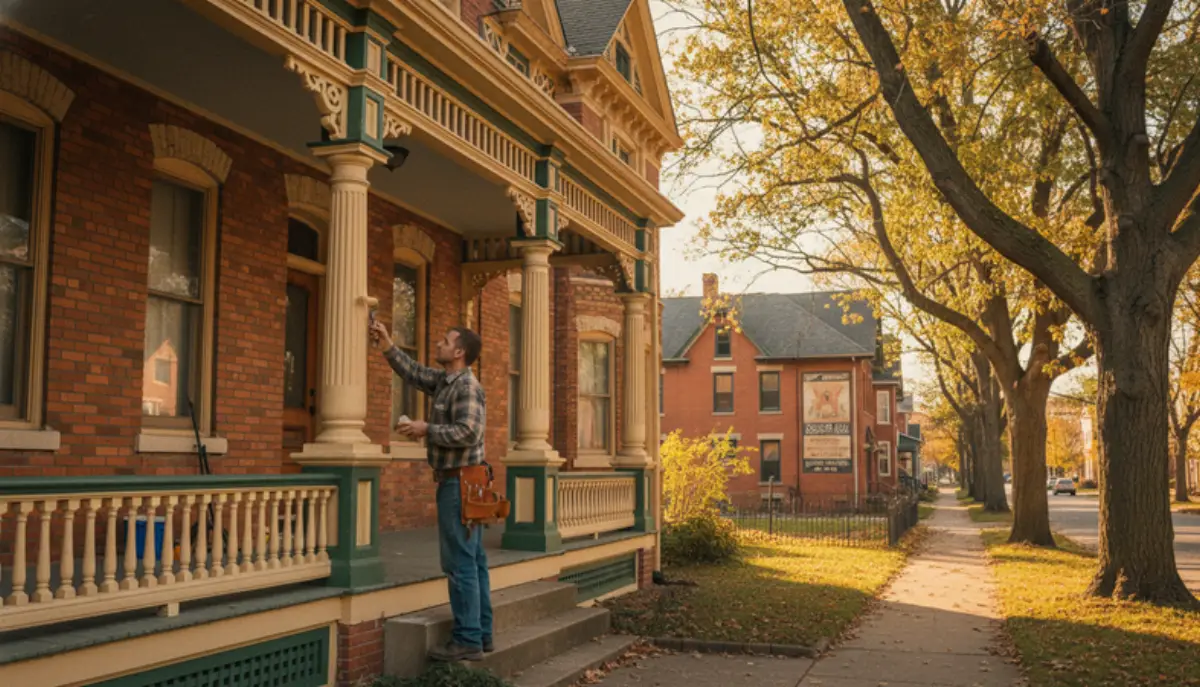
Handyman Projects We See Most in Old West End Toledo
The historic housing stock of Old West End Toledo keeps us busy year-round: wood rot, plaster repair, door adjustment, porch work, and high-ceiling painting.
Old West End Toledo has some of the most impressive residential architecture in the Midwest. It also has some of the most maintenance-intensive housing stock we work in week to week. Brick Tudors, Queen Anne foursquares, and Georgian Colonials built between 1890 and 1930 — same repair categories appear in nearly every walkthrough.
Call 419-574-5623 or book through the portal. Our $89 standard visit covers a hands-on look and a straight quote on whatever’s on your list.
What 90-to-130-Year-Old Houses Actually Need
The first thing to understand about Old West End housing stock: these houses weren’t built badly. They were built with dimensional lumber that modern framing lumber can’t match and plaster-over-lathe walls that outlast drywall when maintained. The problem is ownership turnover. A lot of these houses have passed through 10 or 12 owners. Some stretches were careful. Some weren’t.
What we see in the first walkthrough, almost every time: exterior trim that hasn’t been properly painted in 10–15 years, wood rot on sills and fascia boards along Bancroft Street and Robinwood Avenue, interior doors that won’t latch because the frame has racked slightly after a century of settlement, and at least one bathroom that was updated once — badly — and one that hasn’t been touched since 1974.
Exterior Wood Rot: The Expensive Deferred Item
On an Old West End Tudor or Colonial Revival, the exterior woodwork isn’t decorative afterthought — it’s structural to the look of the house. Deep cornice brackets, carved vergeboard, porch columns with turned details. When that wood starts to rot, you’re dealing with either a preservation-grade repair or a full replacement that has to match the original profile.
We do both. Small sill rot — wood that’s soft in one corner but structurally solid overall — takes an epoxy wood consolidant like PC-Petrifier or Abatron WoodEpox, a prime coat, and finish paint. Total materials run $40 to $70 per sill. A standard $89 visit typically covers two or three sills with good ladder access. Fascia board replacement on a 30-linear-foot run (think the Lincoln Avenue or Scottwood side of a 1.5-story) runs $350–$550 for new wood, installation, and paint. Wide decorative soffits with custom profiles get a specific quote — those aren’t stock lumber.
Plaster and Drywall: Not the Same Repair
Houses built before about 1940 almost always have original plaster over metal or wood lathe. That plaster is thick — typically ⅞” to 1¼” — and more dimensionally stable than drywall in a heated room. When it fails, it fails differently than drywall. Plaster cracks follow the key pattern (hardened squeeze-through behind the lathe), and proper repairs use bonding agent and finish plaster, not joint compound.
We re-do a lot of patch jobs in Old West End where a previous owner used standard joint compound on a plaster wall. That repair cracks. Every time. The compound doesn’t bond and shrinks too much.
For drywall and plaster repair in Old West End, the split runs about 50/50 between true plaster work and drywall repair in sections that were already converted. Plaster repair on a 4-square-foot section with proper bonding and two-coat finish runs $150–$250 depending on texture match. A doorknob hole in standard drywall is an $89 standard visit.
Doors That Stopped Working When the House Settled
A house built in 1910 has settled. The framing has moved. The original mortise locksets — heavy cast-iron mechanisms with skeleton keys — are often still in the doors and work fine mechanically. The problem is the door itself.
What we see most: the latch bolt hits ¼ inch above or below the strike plate opening because the frame has shifted; doors that drag at the top corner because hinges have dropped on hollow-core replacements added in the 1970s; exterior doors that leak cold air around the perimeter because the door has bowed enough that weatherstrip can’t compensate.
Our door repair visits in Old West End spend more time on strike plate adjustment, hinge shimming, and plane-and-sand work than anything else. Single-door fix: $89 standard visit, done in 45 minutes most of the time. An exterior door that needs planing, new weatherstrip, and a replacement threshold gasket runs $175–$250 plus materials.
One thing we won’t do without a conversation: rout out a mortise lockset to install a modern cylindrical lockset. Those original hardware pieces are worth more than the Schlage replacement costs — and most Old West End owners specifically want to keep them.
Interior Painting With 10-Foot Ceilings
High ceilings are a feature. They’re also a production problem. A typical living room on Robinwood or Floyd runs 10 feet to the ceiling, not 8. That’s 25% more wall surface, and it requires taller equipment — 12-foot ladder or rolling scaffold — for ceiling cut-in and the crown molding line.
Our interior painting estimates in Old West End account for this. A 12×15 room at 10 feet (walls and ceiling, no trim) typically runs $350–$500 in labor versus $275–$400 for the same footprint at standard 8-foot height. Trim in an Old West End room is often 5½-inch baseboard plus picture rail plus crown — intricate work that adds time. On plaster, we always skim imperfections first in high-sheen applications — every blemish shows under light at that level.
Porches: What’s Structural vs What’s Cosmetic
Front porches in Old West End range from tight entry stoops to full wraparounds with 8 to 10 columns. The most common issue: porch floors that have separated from the house over the years, with a gap that widens each winter as water freezes in the joint and pushes the structure outward.
Cosmetic repair means replacing individual boards that have rotted through. Structural repair means sistering joists that have softened, shimming the beam back to level, and reflashing the ledger connection at the house wall. We check the ledger first on every porch call. A 1-inch gap at the wall and soft joists is not a painting-and-board-replacement problem.
For porch and deck work that crosses into structural territory on an Old West End property, we pull a Lucas County building permit ($75–$150 depending on scope) and schedule the required inspection. A few blocks also carry local historic overlay designation — call 419-574-5623 before you commit to any exterior material changes on a contributing structure. The Lucas County Historic Preservation Office can tell you in one call whether your address is in the overlay.
Book a Visit
Old West End is one of our most active neighborhoods. Submit a request through the portal with a photo of what you’re working with and we’ll respond same-day with a scope and number. For anything urgent — a door that won’t secure, a porch board that’s gone soft underfoot — call 419-574-5623 directly. We run seven days, 8am–8pm, across West Toledo and the surrounding 10 miles.
What repairs come up most in Old West End Toledo homes?
Exterior wood rot on sills and fascia, plaster repair, door adjustment, and interior painting account for roughly 70% of our Old West End calls. Single-issue visits run $89 in most cases; half-day multi-item punch lists typically land between $250 and $600.
Do Old West End porch repairs require a permit in Lucas County?
Cosmetic board replacement does not. Any structural work — sistering joists, replacing the ledger, rebuilding the beam — requires a Lucas County building permit that costs $75 to $150 depending on scope. We pull permits and schedule inspections as part of the job.
How much does interior painting cost in a high-ceiling Old West End room?
A single room at 10 feet with walls and ceiling (no trim) runs $350–$500 in labor. Adding original trim with baseboard, picture rail, and crown molding puts it at $500–$750. Two-color jobs — ceiling color separate from walls — add roughly 20% to the labor time.
Can you match original plaster finish in a repair?
Yes. Most Old West End plaster repairs call for a smooth skim finish or a very light sand texture — both are part of our standard work. We use veneer plaster or a lime-finish skim depending on what’s adjacent to the repair. The finish coat adds $30–$60 to a standard patch price.
Submit it through the portal
$89 standard visit. Same-day quote. Live photos.
Request a Service